Watch our Most Recent Videos | Visit us on LinkedIn | Visit us on YouTube
API 571 Training Course
I4I Academy provides online API 571 training course (Corrosion and Materials) for Exam Preparation and is available worldwide.
With our money-back guarantee, if you fail to pass your API 571 exam, we will refund your money back to you, no questions asked. However, you must perform all course assignments!
Online API 571 Training Course
The package includes:
- Pass the API 571 Exam on First Try
- 70 course lessons (all API 571 sections covered)
- 800 Practice Exam Question (4 exams and each exam with 100 questions)
- Timed mock up exam (3 exams) Similar to API 571 Exam
- Online Comfort, log on and work on the course whenever you want
- 30 Hours PDH (Profesional Development Hour) Toward 9 Year Certificate Renewal for American Welding Society (AWS) Certified Welding Inspectors
- 30 Hours CDP (Continuing Professional Development) Hour Toward 3 year API 510, API 570, and API 653 Recertification (Applicable after Jan 2023)
- 30 Hours Training credit Toward 6-Year Certificate Renewal for Candian Welding Bureau Certified welding Inspectors
- Instructor Support (If help needed during the study)
- 4 Month Access
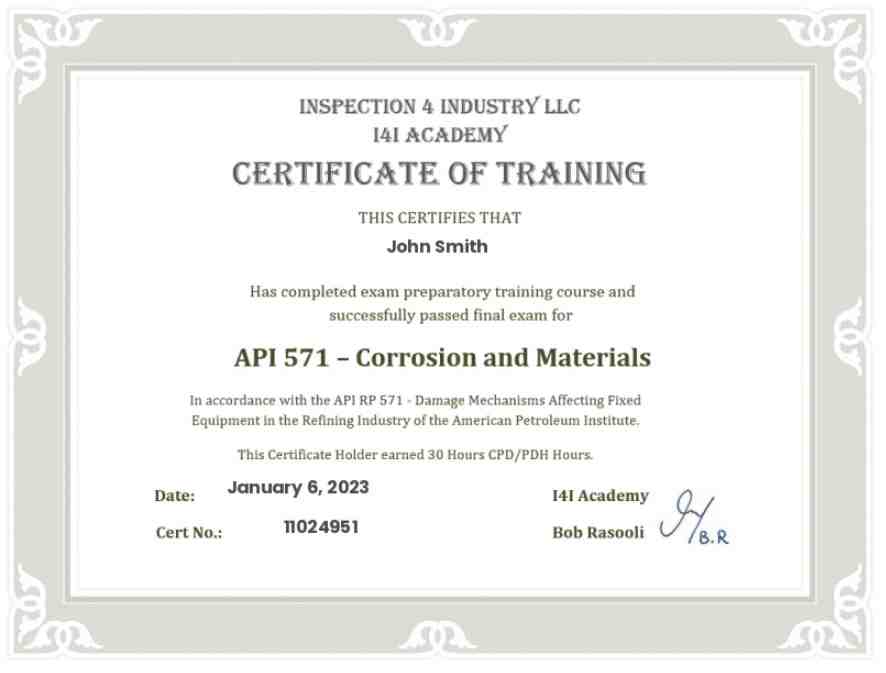
- I4I Academy Certificate
- 48 Hours Money Back Guarantee
When you complete course lessons, you will answer the questions for each practice exam. The system lets you know if your answer is correct or wrong and provides you with a code reference that question being taken.
You are going to take 3 timed mock-up exam similar to API 571 exam. Each exam with 100 questions and with 180 minute time. You can take the exam multiple times until you pass the exam.
This online API 571 training course includes video lessons and practice exam questions to help you prepare for the API 571 (Corrosion and Materials) exam and pass with confidence. Have questions? Contact I4I Academy or call (949) 383-0564.
API 571 Sample Practice Questions
Test your API 571 knowledge with the 10 interactive sample questions below. Inside the I4I Academy portal, you’ll see questions like these—some are single-choice and others are “select all that apply” (checkbox) questions that require you to compare similar damage mechanisms and use the reference numbers to confirm the correct mechanism. As soon as you answer, the system provides immediate feedback and the exact section references so you can verify and learn faster. Start the Interactive Sample Practice Questions →
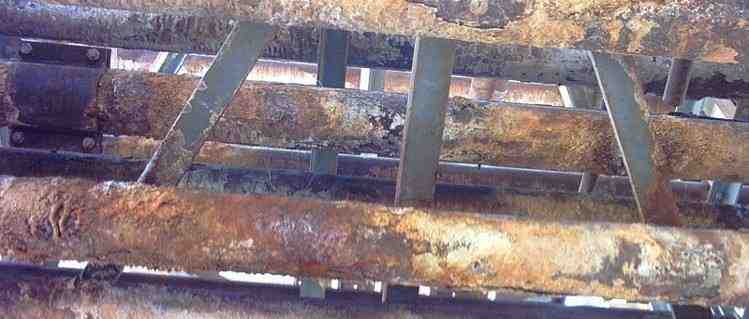
API 571 Sample Flashcards
Test your API 571 knowledge with 6 interactive API 571 sample flashcards. It’s the same practice-style learning you’ll get in the I4I Academy flashcard bank—click a card to reveal the answer and the related API 571 section reference so you can confirm the damage mechanism details and learn faster. Click again to flip back and keep drilling the key concepts until they stick. Start the Interactive Sample Flashcards →
I4I Academy Certificate for API 571 Training Course
Checkout Our API CPD Training Courses:
- API 571 Basic CPD Course (8 CPD/PDH Hours) - 95.00 USD
- API 580 Basic CPD Course (8 CPD/PDH Hours) - 95.00 USD
- API 577 Basic CPD Course (8 CPD/PDH Hours) - 95.00 USD
- API 510 CPD Training Course (16 CPD/PDH Hours) - 184.00 USD
- API 510 Advanced CPD Training Course (24 CPD/PDH Hours) -285.00 USD
- API 570 CPD Training Course (16 CPD/PDH Hours) - 184.00 USD
- API 570 Advanced CPD Training Course (24 CPD/PDH Hours) -285.00 USD
- API 653 CPD Training Course (16 CPD/PDH Hours) - 184.00 USD
- API 653 Advanced CPD Training Course (24 CPD/PDH Hours) -285.00 USD
- API 1169 Training Course - Pipeline Construction Inspector (40 CPD/PDH Hours) - 499.00 USD
- ASME Training Course - Section VIII Div.1, IX and V (40 CPD/PDH Hours) - 499.00 USD
- ASME Section IX Course- Welding Qualification (24 CPD/PDH Hours) - 299.00 USD
- API 1184 Training Course - Pipeline Facility Construction Inspector (40 CPD/PDH Hours) - 499.00 USD
- API 580 Training Course - Risk Based Inspection (30 CPD/PDH Hours) - 349.00 USD
- API 577 Training Course - Welding Inspection and Metallurgy (30 CPD/PDH Hours) - 349.00 USD
- API SIFE Course - Source Inspection Fixed Equiment (32 CPD/PDH Hours) - 499.00 USD
- API SIRE Course - Source Inspection Rotating Equipment (32 CPD/PDH Hours) - 499.00 USD
- API 1104 Training Course - Welding of Pipelines and Related Facilities (30 CPD/PDH Hours) - 349.00 USD
Free newsletter!
Sign up to receive my monthly newsletter covering all the latest courses and updates.
FIND US HERE:


Copyright © 2012-2024 Inspection 4 Industry LLC
Contact Inspection 4 Industry by Email
Contact by Phone - 949-383-0564